
Hancock VINE Custody Coverage
VINE means Victim Information and Notification Everyday. The West Virginia DCR VINE page describes a custody-status and notification service for people held in the state corrections system. DCR operates West Virginia’s regional jails and state correctional facilities. A statewide expansion also brought VINE coverage to all ten regional jails, so the system is the relevant notification layer for a Hancock County person at Northern Regional Jail.
Coverage follows the reporting agency, not the county name alone. Northern is in Marshall County but serves Hancock County. A matching result should therefore be checked for the person’s identifiers and the agency or facility shown. Someone sentenced to a state prison term may appear through the state correctional feed even after leaving Northern’s jail side.
Northern’s combined jail and correctional role makes that agency check essential. A pretrial Hancock detainee, a sentenced jail inmate, and a state correctional inmate can pass through the same complex while leaving different record trails. VINELink can flag a status change, but the DCR jail search, prison search, and court record determine which custody level is involved. A move within DCR should be labeled as a transfer unless the agency says physical custody ended.
VINE is not a universal locator. It does not replace the Federal Bureau of Prisons locator, an ICE custody check, or the Hancock County court record. It also does not explain every legal reason for a change. The agency release event and court order remain the strongest sources for what occurred.
Search Hancock Inmates on VINELink
Open VINELink’s official search and select West Virginia. Choose the offender or custody search offered by the current interface. Use the full legal name first, then try a known alias or identifier if the initial search fails. Never select a result on name alone when date of birth, offender ID, agency, or facility can distinguish two people.
- Select West Virginia and open the available offender or custody search.
- Enter the full name or offender identifier that the form accepts. Check spelling and name order.
- Compare every available identifier, including age or birth information, offender ID, reporting agency, and facility.
- Open only the correct match. Record the status exactly as displayed and note the event date or time when supplied.
- Confirm a surprising release, transfer, or custody result with DCR or Northern Regional Jail.
The official VINELink landing and search screen shows the state-selection route used to begin a Hancock County check.
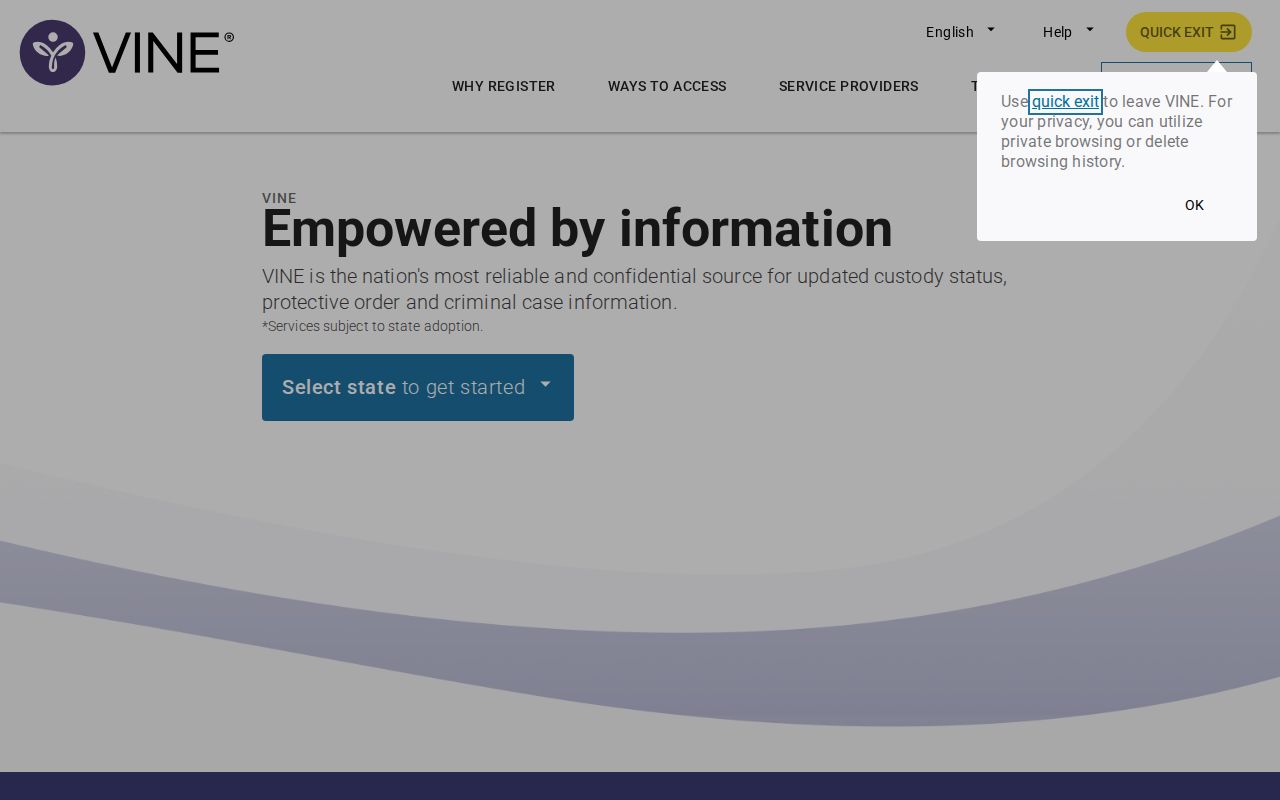
The screenshot is a route into the live service, not proof of any person’s status. The search result and reporting agency must still be matched at the time of the check.
When several results share a name, stop before registering. Compare the available birth information, offender ID, current facility, and agency. A photograph can help when displayed, but it should not replace stable identifiers. If the identifiers are too thin, use the DCR searches or contact the facility before choosing a record. An alert registered to the wrong person can create a false release timeline and cause the correct Hancock County event to be missed.
Hancock VINELink Result Fields
Exact fields can vary by agency feed and by the live VINELink interface. The record may describe the participating agency, person, location, custody status, and available registration control. A released result may say “released,” “out of custody,” or use another phrase supplied by the agency. Record the actual wording instead of converting it into a broader conclusion.
| Result item | How to read it |
|---|---|
| Name and identifying details | Confirm that the result belongs to the intended Hancock County person. |
| Offender identifier | Provides a stable value for DCR follow-up and records requests. |
| Reporting agency or facility | Shows which custody system supplied the event and whom to contact. |
| Custody status | States the agency-fed condition, such as confined, released, transferred, or other live wording. |
| Event date or time | Places the reported change on a timeline when the agency feed supplies it. |
| Notification control | Opens registration for the channels currently offered for that record. |
A release status does not show every condition. It may not state the full court basis, parole terms, destination, or a separate detainer. Pair the VINE result with DCR and the Hancock County case. If the result says transfer, wait for or locate the receiving agency record before deciding that custody ended.
Note: An empty VINELink search is not proof of release; try the DCR jail and prison searches and verify spelling and identifiers.
Register Hancock Release Alerts
Registration begins from the correct person record. VINELink may offer phone, email, text, app, or other channels according to the live service and participating agency. Choose only a method the interface currently displays. Contact details should be entered carefully because a typing error can prevent delivery.
- Open the verified person record and select the registration or notification icon.
- Choose a currently offered contact channel. Enter the phone number, email address, or other destination.
- For a phone alert, create the requested four-digit PIN. Keep it private because it acknowledges receipt and stops repeat calls.
- Complete any email, phone, or contact verification shown by the service.
- Save the confirmation. Follow the instructions in each alert and verify the underlying event with the reporting agency.
The telephone PIN applies to telephone notification. It should not be described as an email requirement unless the live interface says so. Never publish a PIN or store it with public case notes. West Virginia also provides the toll-free VINE number, 1-866-WV4-VINE (1-866-984-8463), for custody information and phone registration.
Save the registration confirmation and keep the contact method current. Telephone alerts may repeat until the PIN is entered, while other channels follow the instructions shown by the live system. If a phone number or email address changes, update the registration instead of assuming the old destination will forward. Registration is tied to the selected person record, so a new custody episode or reporting agency may require the record to be checked again.
An alert proves that VINE received and transmitted an agency event. Delivery may lag, and a transfer alert may wait until the person reaches the receiving facility. Recheck the record when an expected notice does not arrive.
Hancock Formal Release Notice
West Virginia has a second notification layer that must not be confused with ordinary VINELink registration. DCR states that people seeking formal victim notice about qualifying releases or parole hearings should submit written requests to both DCR and the West Virginia Parole Board under the applicable process. A consumer alert can be useful, but it does not automatically satisfy every written statutory-notice requirement.
The statewide design is especially relevant to Hancock County because DCR operates both the regional jail and state correctional system. The statewide VINE expansion notice explains that jail coverage was added alongside correctional-facility coverage. A person can move between those custody levels, and the notification event may depend on when the receiving facility reports arrival.
Someone entitled to formal written notice should follow DCR and Parole Board instructions directly. Keep copies of the request, the agencies addressed, and any confirmation. The ordinary VINELink account can remain active beside that formal route, but it does not overwrite it.
The governing notice route is described in West Virginia Code §62-12-23d. DCR and the Parole Board have different roles: DCR holds and supervises state offenders, while the Board makes parole decisions. Sending a written request to only one body may not cover both a custody release and a parole hearing. Current agency instructions should control the address, proof, and scope of each request.
Hancock VINELink Release Limits
VINELink is only as current and complete as the participating agency feed. A data delay, spelling issue, alias, transfer, protected record, or unmatched identifier can produce an unexpected result. No result does not prove that a person is free. A release notice does not eliminate the chance of another authority’s detainer.
- Custody status
- The agency-fed description of whether the person is confined, released, transferred, or in another reported state.
- Transfer
- A move from one facility or authority to another. Confinement may continue.
- Detainer
- A request or legal hold from another authority that may affect where the person goes next.
- Discharge
- An agency record-closing event whose scope depends on whether it refers to custody, parole, or another status.
Important: VINELink does not track federal BOP custody. Use the federal locator only when the record points to federal prosecution or transfer.
The West Virginia sex-offender registry is also a separate, limited-purpose system. It applies only to people with a registration duty and cannot serve as a general Hancock County release search. A registry match does not prove the date or legal reason for release.
Confirm Hancock Release Events
Start the confirmation with the reporting agency named in VINELink. For a Northern Regional Jail event, compare the DCR jail and prison searches. A person absent from the jail result but present in the prison search remains in state custody. If DCR reports release, obtain the related release or movement record when the reason and destination matter.
Next, read the Hancock case. A magistrate record can show bond, dismissal, disposition, or sentence details. A felony may continue in circuit court, where the signed order gives the durable legal basis. VINE answers the custody-notification question; the court record answers why the judge or case allowed the change. A parole grant is still conditional until DCR reports actual release.
| Person’s custody type | Correct follow-up |
|---|---|
| Regional-jail detainee | Northern/DCR custody event, Hancock case, and VINE status. |
| Sentenced state prisoner | DCR prison search, sentence record, parole decision where relevant, and VINE. |
| Former federal prisoner | BOP Inmate Locator and federal court source; VINELink is not the custody system. |
| Possible ICE transfer | Receiving-agency or ICE check based on a documented detainer or transfer. |
For a complete named-person trail, the Hancock County released-inmate search connects the custody event to court, records-request, state, and federal sources. Preserve the exact wording and time from each source. When two records conflict, use the narrower statement and ask the agency that created the event to reconcile it.