
Hancock Projected Versus Actual Release
The West Virginia Division of Corrections and Rehabilitation uses the field label Projected Release Date when the value is available in a prison offender record. It estimates the custodial endpoint from sentence and credit data currently held by DCR. The value is not the Parole Eligibility Date, a hearing date, a parole grant, or proof that the person walked out. An actual release needs a later status or event record from DCR, VINE, the releasing facility, or the relevant court.
A Hancock County pretrial detainee at Northern Regional Jail is different. Bond, recognizance, dismissal, a time-served order, or another court action can authorize departure, but no prison formula supplies a fixed date before that event. A separate detainer may also keep the person confined after bond is posted. For a short regional-jail sentence, the court's credit and DCR calculation matter, yet the facility event still establishes the gate date.
- Projected Release Date
- DCR's current estimate of the state custodial endpoint when the field is populated.
- Parole Eligibility Date
- The date parole consideration may become available under the sentence and law, not a release promise.
- Actual release
- The documented event when the responsible custodian reports that the person left that custody.
- Detainer
- A request or hold from another authority that can block community release or cause a transfer.
Search Hancock Projected Release Dates
Start with custody level. The DCR offender-search hub separates Daily Incarcerations, the regional-jail search, and the prison offender search. Daily Incarcerations is not a release list. A person missing from the jail search may have moved to the prison system, another facility, or another authority, so a negative jail result does not supply a projected or actual release date.
- Identify the Hancock case, sentencing court, and whether the person is pretrial, serving a jail sentence, or serving a state prison sentence.
- For a sentenced state prisoner, open the DCR hub and choose the prison offender search. Use the most exact name and stable identifier available.
- Open the correct detail and record the offender ID, location or status, sentence and court-order entries, parole fields, and Projected Release Date if populated.
- Compare the public result with the certified Hancock sentencing order, including effective date and concurrent or consecutive structure.
- If a value is blank, stale, or in conflict, ask DCR for the public sentence computation or time sheet and the release or discharge event.
- For a county detainee, check the Hancock court case and contact Northern or DCR for the actual custody event. Do not apply the prison formula.
The Hancock County release search and record process connects the DCR result to the court disposition and movement record. That cross-check matters when one system shows a projection and another shows a new order or transfer. A dated screenshot can document what the public system displayed, but the current agency record controls.
Read the result fields as a group. The offender ID helps distinguish people with similar names. Current location or status shows which DCR branch is reporting the record. Intake and court-order entries tie the calculation to a sentence, while a next-hearing or parole field addresses a different event. The Projected Release Date is most useful only after those identifiers match. A public photograph can help rule out a false match, but it should not be the sole identifier, and it may be a DCR offender image rather than the original Hancock booking photograph.
Note: A blank public field does not establish immediate release; provide DCR the offender ID, case number, and order date.
Hancock Release Date Good Time
West Virginia Code § 15A-4-17 states the general one-for-one rule: an eligible adult inmate in the commissioner's custody receives one day of good time for each day physically incarcerated. Qualifying presentence jail days can count when the sentencing court awards credit under § 61-11-24. Days on bond or parole do not earn this custodial good time. Life-sentenced inmates do not receive good time under that section, and the law includes further exclusions, transition rules, loss and restoration provisions, and mandatory-supervision mechanics.
The statutory language is visible in the official West Virginia good-time law.
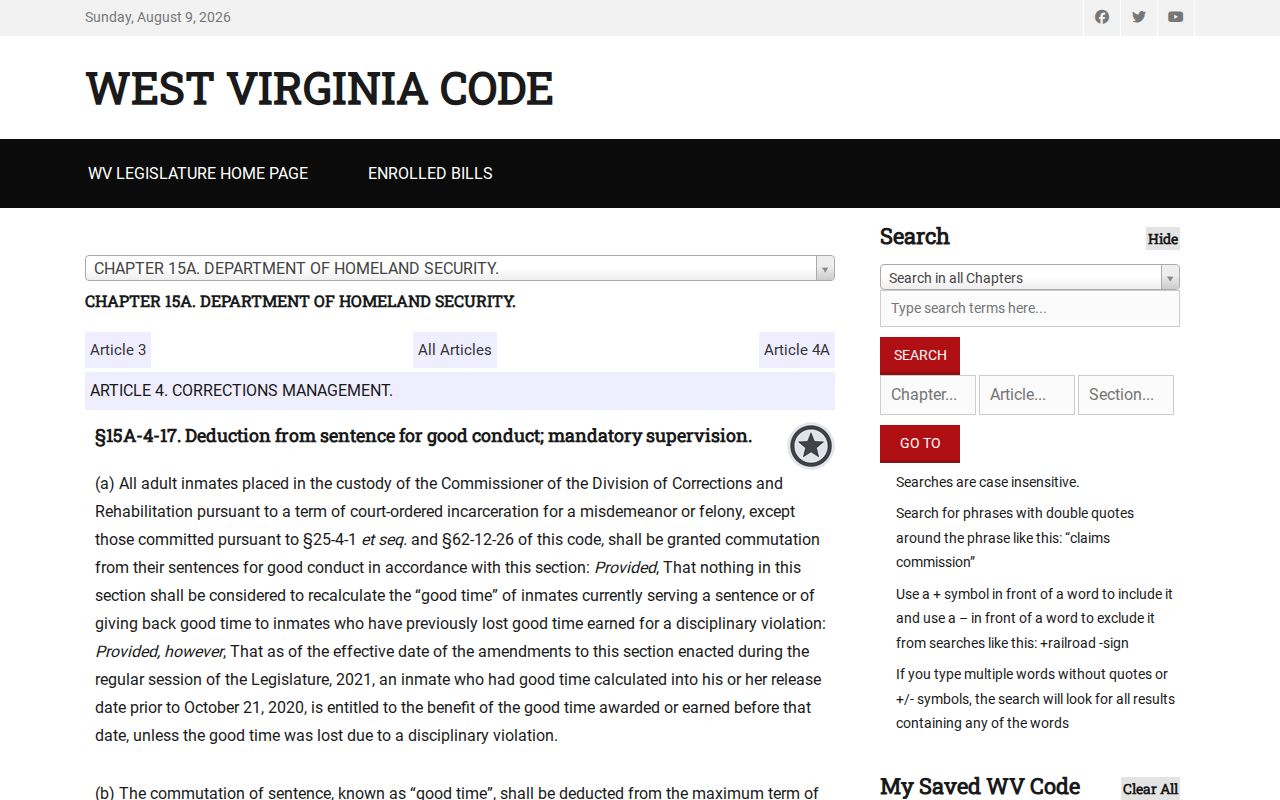
The captured section supports the general rule and its limits. It does not provide a calculator for one Hancock County sentence.
A simple illustration can explain the mechanism without predicting a real date. If a fixed term were fully eligible, each qualifying day confined could be matched by a good-time day against the maximum term. Actual DCR work also applies the effective sentence date, jail credit, concurrent or consecutive sentences, mandatory minimums, disciplinary changes, later court orders, and other custody. The DCR time sheet, not an unofficial web calculation, is the reliable record.
No Universal Hancock 85% Rule
West Virginia state sentences should not be reduced to a broad claim that everyone serves 85 percent. No universal state formula of that kind was found in the official Hancock research. Some offense statutes, mandatory terms, or federal rules can impose different limits, while the general West Virginia good-time statute uses the one-for-one structure for eligible physical custody days. Sentence type and offense date still matter.
Parole uses another calculation. Section § 62-12-13 generally addresses the minimum of an indeterminate sentence or one fourth of a definite term, but it also contains major exceptions and special categories. Section § 62-12-13a states that an indeterminate minimum creates eligibility, not a right to release. A Projected Release Date and PED must therefore remain separate labels.
The parole-eligibility distinction appears in the official West Virginia parole statute.
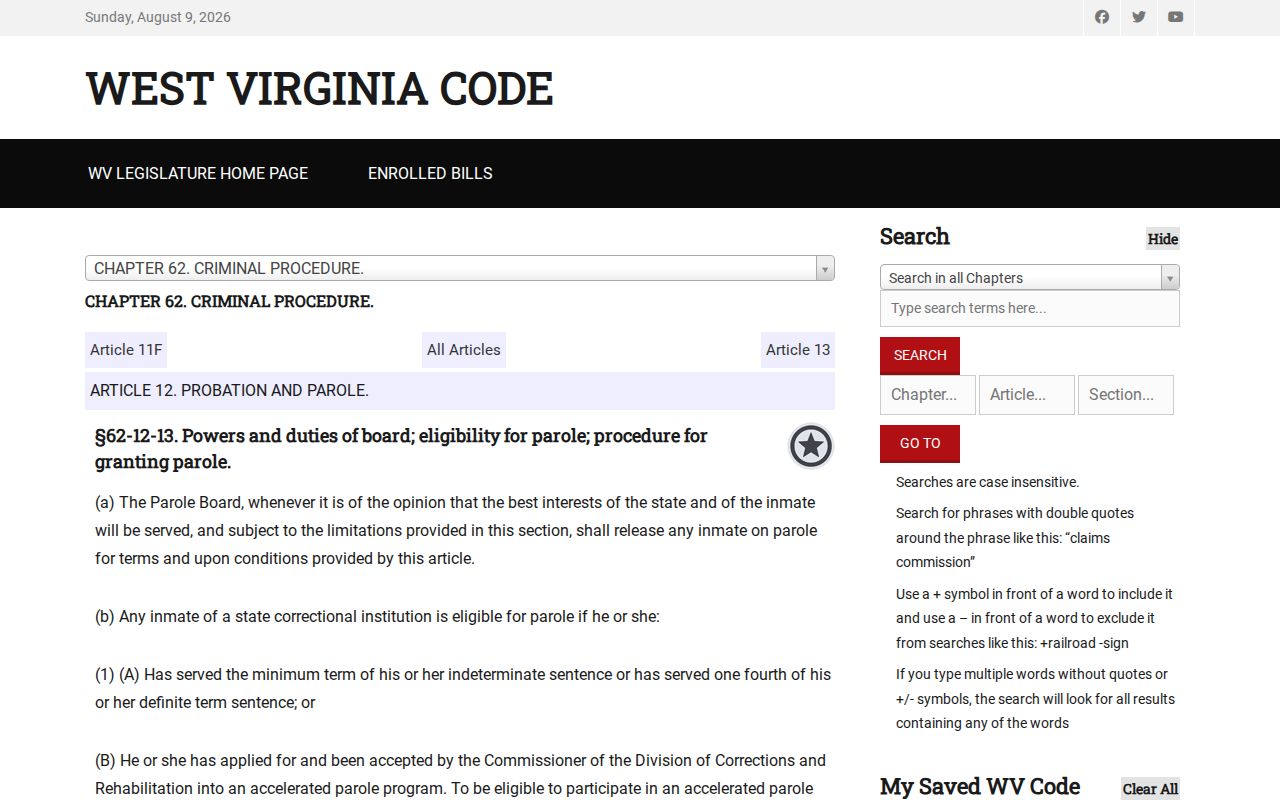
The statute capture shows why an eligibility point cannot be reported as the day a Hancock County prisoner will leave custody.
Why Hancock Release Dates Change
DCR recalculates when a controlling input changes. Some corrections are favorable, such as verified jail credit. Others move the estimate later, such as lost good time or a newly entered consecutive sentence. A new date is not necessarily an error. The key question is which order, credit entry, disciplinary action, or custody hold changed the computation.
| Factor | Possible effect | Best confirming record |
|---|---|---|
| Corrected presentence credit | Moves the estimate after qualifying jail days are added or corrected | Sentencing order and DCR time sheet |
| Amended or vacated sentence | Changes the term, start point, or valid sentence structure | Certified court order |
| Concurrent or consecutive case | Combines terms differently and may extend the endpoint | Judgments and DCR computation |
| Good-time loss or restoration | Moves the date later or earlier under agency rules | DCR computation and public supporting record |
| Parole action | May allow earlier conditional release, delay it, or rescind an expected release | Board decision and DCR release event |
| Detainer or other authority | Can cause transfer instead of community release | Movement record and receiving-agency confirmation |
A data correction can also change only the public display. When two dates conflict, avoid quoting either as final. Ask for the current sentence/minimum-discharge statement, the computation history that can be released, and the certified Hancock orders on which DCR relied.
Note: A past projected date is historical evidence of an estimate, not proof that release occurred on that date.
Hancock Parole and Mandatory Release
A parole grant can shorten physical confinement, but it does not end the sentence. The Board's decision may depend on an approved home plan, programs, or other conditions. Actual departure can occur after the decision date, and a detainer can route the person to another authority. Confirm the gate event in DCR or VINE, then verify ongoing supervision through Parole Services.
West Virginia Code § 15A-4-17a also authorizes a mandatory supervised-release plan for certain felony inmates who have not received discretionary parole before minimum expiration. Mandatory supervision is a release framework, not an automatic date shown by a generic formula. Eligibility, exclusions, the actual plan, and DCR's computation remain specific to the person.
These distinctions also explain why a person may be out of prison yet still appear in correction or supervision records. The Hancock County Probation & Parole page separates the Board decision from the office that supervises a released person.
Confirm Hancock Actual Release
For a state prisoner, confirm the latest DCR status and request the release or discharge event when exact proof is needed. West Virginia VINE may issue a custody-status alert based on agency data. It is useful for a pending change, but it does not state every legal condition and does not replace a certified release sheet. If another authority takes custody, the alert may reflect transfer language rather than release to the community.
For a Northern Regional Jail detainee, start with the Hancock case and the regional-jail custody record. A posted bond or dismissal can authorize departure, while a hold can delay it. Ask for the release timestamp, release type, releasing authority, and destination or receiving agency. Those fields establish what happened far better than a projected prison date applied to the wrong form of custody.
When the public prison field is unclear, send a focused DCR request for the public sentence computation, Projected Release Date, credited presentence time, method of discharge, and actual release event. Give the offender ID, Hancock case number, and order date. A narrow request helps the custodian locate the right record without asking the agency to create a new calculation.
Ask for the code legend if the response uses abbreviations. “Released,” “transferred,” “paroled,” and “discharged” can close one custody episode while describing very different legal outcomes. A transfer to another DCR facility, federal custody, or an outside authority is not community release. Parole ends confinement conditionally but leaves a supervision record. Discharge may describe the end of confinement or supervision, depending on the record series. The destination and releasing authority keep those terms from being read out of context.
The Hancock court file provides the legal side of the comparison. A magistrate entry can show bond, dismissal, or time served, but a felony complaint may continue in circuit court. The certified circuit judgment and amended orders are stronger than a short docket label. When a court order and DCR estimate disagree, give both documents to the custodian and ask which order is reflected in the current computation. Avoid selecting the earlier date merely because it is more favorable.